
Giuseppe Pezzini on Tolkien
Over the past decade, I have developed a research interest in Tolkien’s literary practice and theory at the intersection of classical philology, ancient philosophy of language, literary theory, and classical reception. This work has resulted in a body of Tolkien-related publications, including a monograph on Tolkien’s literary theory (Cambridge University Press, 2025), three edited volumes, and several articles, chapters, and reviews. It is complemented by my work as Tolkien editor of the Journal of Inklings Studies (published by Edinburgh University Press) and as one of the founders of the Oxford Tolkien Network: this is a research project at the University of Oxford, which has organised seven seminar series (2023–2026) and three conferences, most recently on Patterns of Xenia in Tolkien’s Works, in collaboration with the University of Turin. The network currently includes several Tolkien scholars based in the University, two DPhil students, whom I supervise, as well as a three-year Postdoctoral Fellow, who has recently begun her tenure under the supervision of Professor Simon Horobin, Chair of the English Faculty and English Fellow at Magdalen College, and myself.
My principal contribution to Tolkien studies has been to uncover and contextualise Tolkien’s classical roots and influences, correcting the long-standing and disproportionate emphasis on his medieval and medievalist sources. Tolkien was himself a classicist: he learnt Latin from an early age, received an exceptionally demanding classical education at school, and sat Oxford Honour Moderations in 1913. He also explicitly acknowledged classical analogies and influences, from the “Homeric catalogue” preceding the siege of Minas Tirith to the Atlantis-like fall of the Kingdom of Númenor. Recovering this classical dimension contributes to a fuller appreciation of Tolkien’s literary sophistication and challenges reductive categorisations of his writings as merely fantasy, popular, or children’s literature.
Several of my publications address Tolkien’s classical reception directly, combining Quellenforschung with narratology and literary criticism. I have examined, for instance, Tolkien’s creative use and subversion of ancient narratives of decline, his adaptation of the Homeric motif of ambiguous xenia, and his transformation of epic models of relationships between gods and humans. I have also placed Tolkien’s classicism within broader literary and intellectual contexts, particularly First World War literature, and within the English Romantic tradition and its reception of antiquity. An important figure here is John Henry Newman, whose own classical reception I have investigated in an article.
A second major strand of my research concerns Tolkien’s linguistic theory and practice. I situate his thought about language both within modernist debates over linguistic experimentation – as suggested, for example, by his notes on Joyce’s Finnegans Wake – and within the much longer tradition of ancient linguistic naturalism, mediated particularly through Owen Barfield and his Platonic interests. The opening chapter of my monograph develops this approach from questions I had previously explored in my work on ancient linguistic naturalism. This theoretical research extends to the linguistic construction of Tolkien’s legendarium. His invented languages draw on ancient languages, especially Latin and Greek, not simply in their lexicon and morphology but also in their diachronic development and sociolinguistic differentiation.
I have pursued these research questions through academic publications, but also through my work as a Tolkien consultant. In particular, I was involved from its inception in the development and promotion of a memorial to Tolkien in Poets’ Corner, Westminster Abbey – which has recently been announced – and I have acted as a Tolkien consultant on film productions written and produced by Peter Jackson and his team. Taken together, these strands seek to establish classical literature and classical philology as central contexts for understanding Tolkien’s distinctive literary and intellectual achievement.
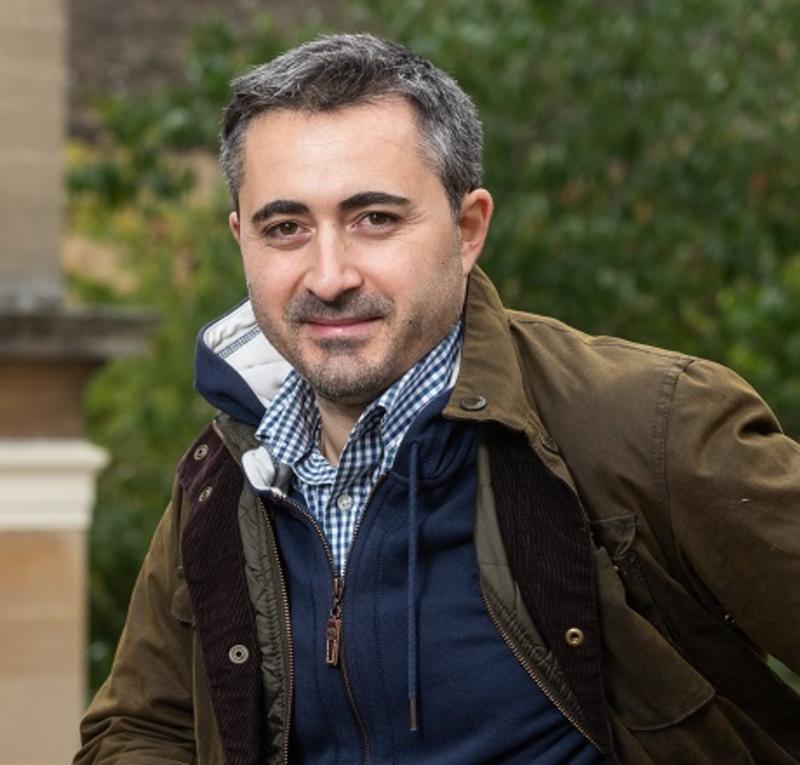
Professor Giuseppe Pezzini, Associate Professor of Latin Language and Literature, Corpus Christi College.

