

The FRRAnt Project: Fragments of the Roman Republican Antiquarians
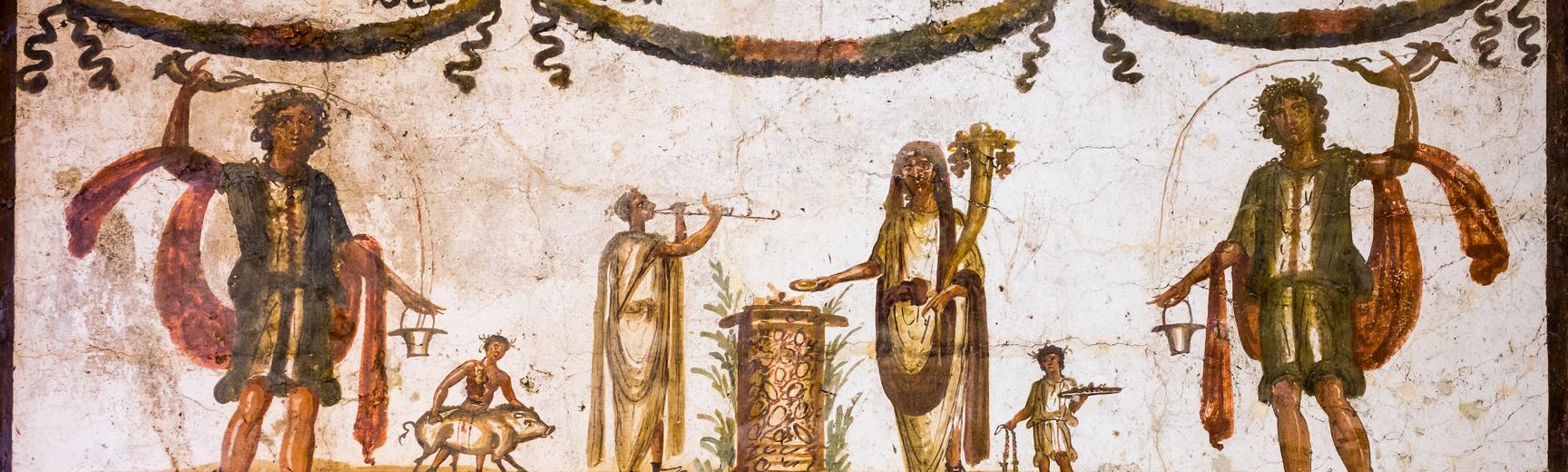
Ordering, Constructing, Empowering: Fragments of the Roman Republican Antiquarians (FRRAnt) is an ERC-funded research project that aims at reconstructing in full, for the first time, the phenomenon of Roman Republican antiquarianism.
It will do so by establishing the texts and contexts of the Roman Republican antiquarians, writers whose construction of the past shaped Roman cultural identity and the religious and institutional system of the Republic. Their works constituted a revolutionary new genre that re-shaped the Roman intellectual horizon and was understood in the 19th century as a distinctive ‘antiquarian’ moment. By making available for the first time a synoptic view of Roman Republican antiquarians, FRRAnt will transform our understanding of Roman Republican culture. This, in turn, will have an enormous impact on the study of those later periods, which look back at Rome as a focal point of cultural reference.
Project Aims
The main aim of FRRAnt is to produce the first-ever complete critical edition of the fragments of the Roman Republican antiquarians, which will be philologically rigorous and historically transformative, both as a printed edition and an online database. Supplying this edition with English translation, commentary, and introductions to each author, as well as with a series of accompanying volumes, FRRAnt’s ambition is to launch the study of these texts as a major new departure for the study of the ancient world and of the classical tradition from the Renaissance onwards.
There are two main issues in dealing with the production of the antiquarians: first their works are mainly preserved in a fragmentary way, through quotations in later authors, often in texts of a completely different nature, and secondly, later scholarship has tended to divide this material in subfields of knowledge and so obscuring its deeper continuities, and undermining their collective contribution to the political and philosophical debate in ancient Rome.
To address these issues the printed edition will be accompanied by an online database. This electronic system will allow not only collecting, sharing and querying the research data by the project team, but also transforming the data into formats for external use. These data stored in the database will also be linked with pre-existing material, thus the database will contain a higher quantity of information pertaining to issues of both content and text than the printed edition. This would benefit in particular those researchers who are not interested in Republican antiquarianism per se, but rather in related fields.The advantages of the online database will be to provide the user with the opportunity not only to access this material in translation, but also to order it as preferred, making the most of ‘breaking free of the impossibility of assigning fragments to books’ by allowing users to arrange the material according to their judgment and explore more widely the intellectual landscape of the Republic.
Ancient History and the Antiquarian
Considering the enormous – almost constitutive – influence of antiquarian studies over the course of early modern and modern cultural history, it is remarkable how little attention has been paid to the nature of these works in t original context of ancient Republican Rome. One of the most authoritative scholars in the field, Arnaldo Momigliano, in his study ‘Ancient History and the Antiquarian’ published in 1950, first established the field of antiquarian studies by referring to changes introduced by disciplinary knowledge and in relation to history. However, Momigliano’s brilliant essay has also tended to constrain subsequent scholarship. Building on the Saussurean distinction between the synchronic and the diachronic, Momigliano advocated that ancient antiquarianism was characterised by a distinctive interest in remote changes along a synchronic axis. However, this distinction is overstated, and created too sharp a dichotomy between history and antiquarianism, setting up the historian against the antiquary.
Not only did textual exegesis combine philology with an understanding of the history of religion, legal practices, and literary works, but also classical lexicography took precisely the form of the study of etymology. Whether investigating Roman history, language, family genealogy, jurisprudence, religious lore, or political procedure, antiquarian tools were historical research and etymology, a genealogical-reconstructive method which was substantially inductive and aimed to work back from the present. As a result, two main consequences in the investigation of different ways of recording and narrating the past followed: first, a focus on the issue of the definition of antiquarianism vis-à-vis history; the second a disregard of the pivotal role played by philology in the development of antiquarian studies.
Project details
Between Nov. 2020- Sept. 2024 FRRAnt was hosted by UCL and in 2024 moved to the University of Oxford with UCL as beneficiary, when Prof. Valentina Arena, the project PI, was appointed Camden Professor of Ancient History at Oxford.
'Ordering, Constructing Empowering, Fragments of the Roman Republican Antiquarians' has been funded by the European Research Council (ERC) by the European Union's Horizon 202o Research and Innovation Programme grant agreement no. 866400
The European Research Council
The European Research Council (ERC) awards Consolidator Grants of up to €2 million for 5 years to excellent researchers in their field.
The ERC’s mission is to encourage the highest quality research in Europe through competitive funding and to support investigator-driven frontier research across all fields, on the basis of scientific excellence. In the long term it looks to substantially strengthen and shape the European research system.

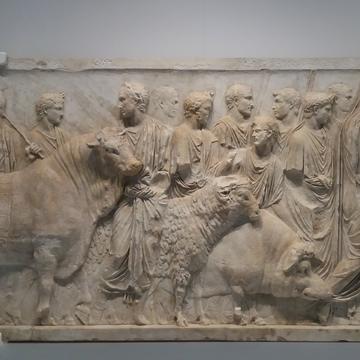
Suovetaurilia from altar of Domitius Ahenobarbus
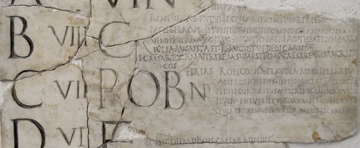
Fasti Praenestini
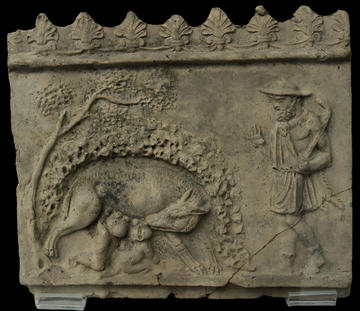
Faustulus finds the she-wolf with Romulus and Remus, Campana plaque, 2nd c. CE

Topographical Map of Ancient Rome 1557 from Speculum Romanae Magnificentiae
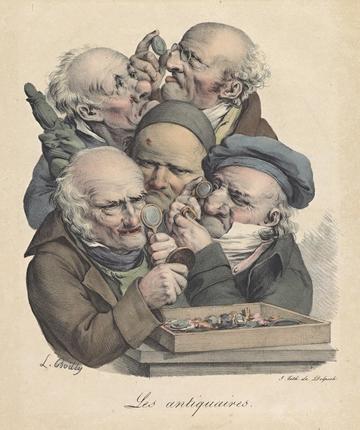
Les Antiquaires, Louis Léopold Boilly,1823
The primary aim of FRRAnt is to produce the first-ever complete critical edition of the fragments of the Roman Republican antiquarians, which will be philologically rigorous and historically transformative, both as a printed edition and an online database. Supplying this edition with English translation, commentary, and introductions to each author, as well as with a series of accompanying volumes, FRRAnt’s ambition is to launch the study of these texts as a major new departure for the study of the ancient world and of the classical tradition from the Renaissance onwards.
The online database will allow not only collecting, sharing and querying the research data by the project team, but also transforming the data into formats for external use. These data stored in the database will also be linked with pre-existing material, thus the database will contain a higher quantity of information pertaining to issues of both content and text than the printed edition. This will benefit those researchers who are not interested in Republican antiquarianism per se, but rather in related fields.
The advantages of the online database will be to provide the user with the opportunity not only to access this material in translation, but also to order it as preferred, making the most of ‘breaking free of the impossibility of assigning fragments to books’ by allowing users to arrange the material according to their judgment and explore more widely the intellectual landscape of the Republic.
The database is being is being developed by UCL's advanced computing team. It will be made available to the public in the coming months via this link.

Valentina Arena is Camden Professor of Ancient History at the University of Oxford and Principal Investigator of the FRRAnt project.. Her work focuses on the history of ancient ideas and ancient political thought as well as the wider intellectual landscape of the Roman Republic.She has investigated ancient theories of liberty and how they relate to their intellectual and political contexts as well as their potential contributions to contemporary political debates. She is the author of Libertas and the Practice of Politics in the late Roman Republic (Cambridge 2012) and the editor of Liberty: an Ancient Concept for the Contemporary World (special issue of Journal of the History of European Ideas 2016, republished by Routledge Liberty: Ancient Ideas and Modern Perspectives 2021).
Please find her profile here.
Valentina was previously Professor of Ancient History at University College London
Details of the other members of the team can be found here
Since the project moved to Oxford in October 2024 the FRRAnt project has hosted the following events:
1. Workshop on Cicero’s Academici Libri, May 9th and 10th 2025 Brasenose College, Oxford.
Chair: Tobias Reinhardt (Oxford)
Giorgio Piras, ‘Varro philosophus’: the character of Varro in Cicero's Academica
Orazio Capello, Thinking Historically in Philosophy: Models of Philosophical Historiography in Cicero
David Blank, Diogenes of Babylon, Antiochus, and the History of Academic Epistemology in Cicero
Irene Leonardis, Approaching Varro: Cicero’s opening gambit through the Academici libri
Yelena Baraz, Meeting in the middle: translation and/as access to knowledge
Ermanno Malaspina, The studia of Lucullus, Varro and Cicero: A reappraisal in the light of the letters to Atticus and Fam. IX, 8.
Stephen Blair, Cicero’s Academici Libri and FRRAnt
2. The Law Before Magna Carta May 12, 2025 a workshop at the Society of Antiquaries of London
Ahead of its Magna Carta 1225 exhibition in the summer, the Society of Antiquaries of London ran a workshop in partnership with colleagues on Project FRRAnt. The workshop showcased key findings of this European Research Council-funded project, looking at how the Romans approached matters of jurisprudence. Professor Valentina Arena FSA (Camden Professor of Ancient History, University of Oxford) provides an overview of the project.
With expert talks from Dr Antonino Pitta (Catholic University of Milan, and FRRAnt team member) and Professor Anthony Musson FSA (Historic Royal Palaces and Council member and Trustee of SAL). FRRAnt project members organised a show and tell of Roman objects from our collections, and opportunities to reflect on the meaning of Magna Carta then and now.
The event was supported by the National Lottery Heritage Fund as part of the Magna Carta 1225 exhibition.
3.The Prodigies, the Landscape and the Antiquarian: Latium Vetus in the Roman Republic seminar at Brasenose College 2 Feb 2026 with Dr Garofalo (Lisbon)
4. Synchronic Pasts: Comparing Ancient and Early Modern Antiquarianism, University of Rome, Sapienza 15-17 June 2026
Valentina Arena (University of Oxford, FRRAnt): Welcome and Introduction
Keynote: William Stenhouse (Yeshiva University, NYC): Affective Antiquarianism
Panel 1: Language
Francesco Ursini (University La Sapienza, Rome)
Anna Chahoud (Trinity College Dublin): The (Latin) Language as a Cabinet of Curiosities
Clementina Marsico (Università di Firenze): Antiquarian Reflections on Language: the Humanist Lens
Panel 2: Clothing
Chair: Francesco Ursini (University La Sapienza, Rome)
Martina Farese (University La Sapienza, Rome, FRRAnt): Dress to Express: Roman Antiquarianism on Clothing and Old Fashion
Damiano Acciarino (University Ca’ Foscari, Venezia): Understanding the Toga. From Medieval Encyclopaedism to Renaissance Antiquarianism
Antonino Pittà (Università Cattolica del Sacro Cuore, Milano, FRRAnt): Comparative Remarks and Discussion
Panel 3: Fasti
Chair: Antonino Pittà (Università Cattolica del Sacro Cuore, Milano, FRRAnt)
9.00-9.45am Tim Cornell (University of Manchester): Fasti and Annales: the formation of the republican consul list
9.45-10.30am Ginette Vagenheim (Université de Rouen): Pirro Ligorio (1512c-1581) and the discovery of the Fasti Capitolini in the Roman Forum in 1546
Panel 4: Statutes
Chair: Antonino Pittà (Università Cattolica del Sacro Cuore, Milano, FRRAnt)
Pierangelo Buongiorno (Università di Macerata): Ordering the Past: Statutes and Legal Institutions in Roman Antiquarian Knowledge
Giovanni Rossi (Università di Verona): Beyond Justinian’s “libri legales”: studying Roman statutes and reconstructing ancient history in the Renaissance
Daniele Miano (Univeristy of Oslo): Comparative Remarks and Discussion
Panel 5: Rituals
Chair: Daniele Miano (University of Oslo)
2-2.45pm John Scheid (Collège de France), online: Antiquarianism as a political weapon. The seizure of power by Octavian Augustus
2.45-3.30pm Frances Muecke (University of Sydney): Where are the Rituals? From Biondo Flavio’s “Roma triumphans” (1459) to Lilio Gregorio Giraldi’s “De deis gentium varia et multiplex historia” (1548)
Panel 6: Topography
Daniele Miano (University of Oslo)
Domenico Palombi (University La Sapienza, Rome): Ut possemus aliquando qui et ubi essemus agnoscere (Cic. Acad. 1.9). Antiquarianism and the city
Jessica Maier (Mount Holyoke College, USA): The Technical Turn in Early Modern Topography
Giorgio Piras (University La Sapienza, Rome, FRRAnt): Comparative Remarks and Discussion
Panel 7: Magistrates
Chair: Giorgio Piras (University La Sapienza, Rome, FRRAnt)
Peter Wiseman (University of Exeter), online: Roman Antiquarians on Roman Magistrates
Shingo Akimoto (Université Paris-Panthéon-Assas): Imperium or Potestas? Antiquarian versus Legal Sources in Sigonio and Bodin’s Reconstruction of Roman Magistracies
Christopher Smith (St Andrews University, FRRAnt), online: Comparative Remarks and Discussion
Keynote: Peter Miller (President American Academy in Rome): If antiquarianism is bound up with history, and if antiquarianism is also bound up with conservation, then what is the relationship between history and conservation?
To date, 26 papers have been published, a further 11 are forthcoming (publication delay mainly connected to the Covid-pandemic), and 11 are in press or in an advanced state of preparation. A major volume, co-edited by the PI and one of the post-doctoral researchers, and to which three team members have contributed an essay, is in an advanced state of preparation and will be published by Cambridge University Press.
To find the current list of publications please follow this link.

