

Muons and gold
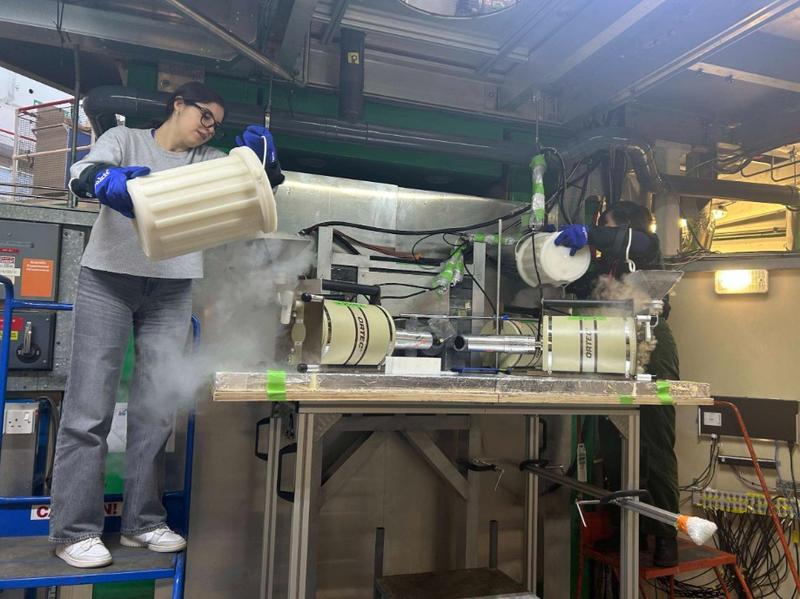
Ordinarily, when walking around the Faculty of Classics in Oxford you would be safe to assume that they must have said they work on the letter mu (μ). For the previous century you’d be absolutely correct, but in the last few years μ has taken on a very different role for us. We now use a particle accelerator to shoot muons (μ−) at ancient gold coins.
A muon is a type of subatomic particle called a lepton, but it is much easier to think of it as a “fat electron”: an electron with mass. By accelerating the muons, we can give them varying levels of momentum and, depending on that momentum, we can implant them at specific depths within the objects we want to analyse.
Once they’re implanted at a specific depth, they are captured by the atoms there. Muons don’t particularly like this, so they release most of their energy in the form of a muonic X-ray. The energy of this X-ray is indicative of the element that captured the muon, meaning that, by detecting all these muonic X-ray emissions, we can work out the composition of our sample deep beneath the surface, totally non-destructively.
There are a handful of muon sources in the world, and only two or three that can carry out this sort of elemental analysis, so we are very lucky to have a direct bus route to the ISIS Neutron and Muon Source at the Harwell Science Campus.
For archaeologists, being able to non-destructively analyse the insides of expensive objects is a bit of a dream come true. We don’t want to cut things up, so we often rely almost exclusively on surface analysis, but if there are any worries that the very surface of the object isn’t representative of the core, then these analyses are called into question. For ancient gold coins we can have lots of these worries: surface contamination, environmental leeching, deliberate gilding, or a naturally “messy” alloy. The muon technique can help us navigate around all these problems.
Understanding exactly what an archaeological object is made of can give us an insight into the society that produced it. Coins especially are “documents”, and scientific analyses allow us to “read” the history hidden within these “documents” in a new way.
Our key Roman case study looked at the AD 68/69 Civil Wars and their aftermath, most famously known for having the ‘Year of the Four Emperors’. This was a known time of crisis and money was almost certainly short. We also knew that the Romans had recently started surface enriching their silver coins, making them look high-purity silver on the outside while being far less silver in the middle. As such, the very reasonable suspicion was that our understanding of this period was being distorted by the gold coinage also being surface enriched. Finances could be stretched by creating a gold-silver alloy coin, chemically stripping the silver out from the surface, and then issuing it as a pure gold coin.
Using muons we were able to take a non-destructive ‘slice’ right in the middle of gold coins from the AD 68/9 Civil Wars. This enabled us to analyse the interiors of the coins separately from the surfaces. Our results clearly showed that the Romans were not surface enriching their gold coins even during a time of acute fiscal crisis, however, that doesn’t mean they weren’t cheating – we were able to show that they were occasionally using copper to ‘cover up’ that some coins were not pure. The copper provided a cheap way for pale, light-yellow electrum to be darkened and made to look like pure gold.
We extended the muon analyses into the first few years of Vespasian’s reign. This was crucial as it allowed us to assess the financial ripple effects of the preceding civil wars. By analysing the very centres of Vespasian’s gold we were able to be totally confident that the purities we were seeing were ‘real’ and not an artefact of surface contaminations or alterations. These results showed that it took Vespasian around four years to return to a full purity gold coinage after he had won the throne.
Beyond this project, I have had muon time to investigate humanity’s first money, the early electrum coins produced in the Kingdom of Lydia; the particularly messy gold of the ancient Ethiopian kingdom of Aksum; and heavily corroded Roman amber jewellery. Archaeological and historical projects are valuable ‘discovery research’ in their own right, but they also take these cutting-edge scientific facilities into unusual contexts and areas. By asking different questions and imposing different restrictions on the techniques compared to regular industrial and scientific users, we help to catalyse instrument innovation and development. Improving these techniques doesn’t just benefit us, but the groups researching batteries, energy materials, avionics, advanced manufacturing material and superconductivity (amongst others) too. As an example, a team in Canada realised they could apply the muon technique to their work on the corrosion of nuclear reactors after seeing our work profiling the composition of ancient coins.

